• eu-LISA Multilingualism Policy

    According to eu-LISA Management Board decision (No 2017-037 REV 1), the working language of the eu-LISA is English. English is also predominantly used by the main stakeholders of the Agency, operating at European level for public consultations, meetings and the publication of technical, legal or policy documents. The vast majority of eu-LISA communication is conducted in English. Where appropriate, the
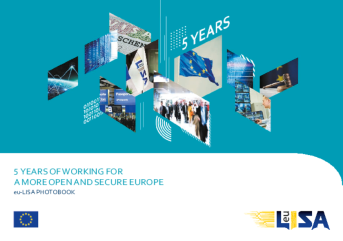
  • 5 Years of Working for a more Open and Secure Europe

    In 2017 eu-LISA celebrates its fifth year of operations. These first five years have been an exciting journey as we built up a dynamic and agile organisation. Today, we provide high quality services and solutions to EU Member States, contributing to their efforts to make Europe safer. These five years have been challenging, but rewarding. In this short time, eu-LISA

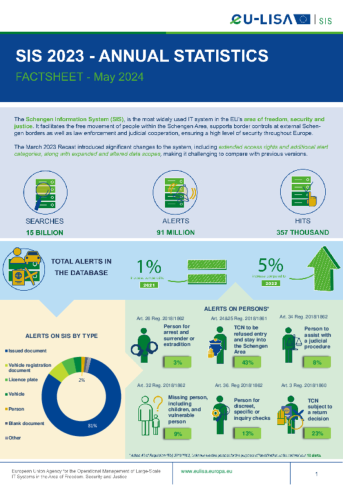
  • SIS - 2023 Statistics - Factsheet

    The SIS 2023 Statistics factsheet highlights the main results of the data found in the full statistical report for 2023 that can also be found on this website.

  • SIS - 2023 Statistics - Report

    The SIS 2023 Statistics Report is an annual public statistical document, published by eu-LISA, presenting a collection of data received from Member States and Associated Countries connected to SIS, combined with data available from the Central SIS system, as per the legal instruments governing the system. This report is accompanied by a factsheet that can also be found on this

  • SIS - List of competent authorities 2023 - Updated

    Each year, since it assumed the operational management of the system, eu-LISA publishes the list of competent authorities which are authorised to directly search the data contained in SIS as well as the list of National SIS Offices and SIRENE Bureaux. The present consolidated list is based on information communicated by Member States by 10 November 2023. The Schengen Information

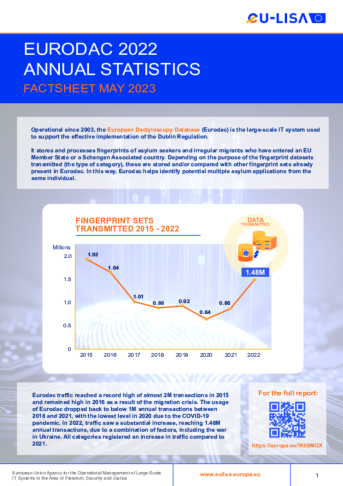
  • Eurodac - 2022 Statistics - factsheet

    Eurodac is the centralised European database that stores and processes the digitalised fingerprints of asylum seekers and irregular migrants who have entered a European country. This helps determine the Member State responsible for examining an asylum application. Eurodac stands for EUROpean Asylum DACtyloscopy database. Pursuant to Article 8(2) of Regulation (EU) No 603/2013, at the end of each year eu-LISA

  • Eurodac - 2022 Statistics - report

    Eurodac is the centralised European database that stores and processes the digitalised fingerprints of asylum seekers and irregular migrants who have entered a European country. This helps determine the Member State responsible for examining an asylum application. Eurodac stands for EUROpean Asylum DACtyloscopy database. Pursuant to Article 8(2) of Regulation (EU) No 603/2013, at the end of each year eu-LISA

  • Eurodac - List of designated authorities with access to Central System data 2023

    This is the list of designated authorities which have access to data recorded in the Central System of Eurodac pursuant to Article 27(2) of the Regulation (EU) No 603/2013, covering the purpose laid down in Article 1(1) of the same Regulation. The list was initially published on the OJ C237 on 20.07.2015. Where there are amendments thereto, the Agency shall

  • SIS - List of competent authorities 2023

    Each year, since it assumed the operational management of the system, eu-LISA publishes the list of competent authorities which are authorised to directly search the data contained in SIS as well as the list of National SIS Offices and SIRENE Bureaux. All linguistic versions are available on this page and in the Official Journal of the European Union. The Schengen